
1. TYPES OF FARM EQUIPMENTS
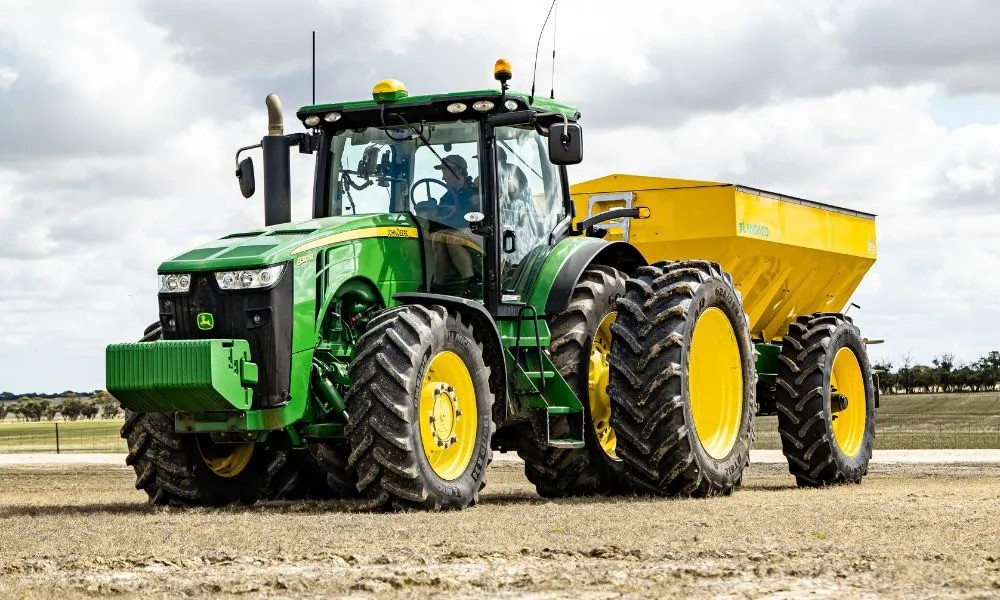
- Tractors: Standard tractors are versatile and can handle tasks like hauling, plowing, and tilling. Models that are popular for durability and fuel efficiency are the John Deere 5045D and the Mahindra 575DI XP Plus. Mini tractors like Mahindra Yuvraj 215 are suitable for marginal and small farmers and are affordable, easy to operate, and compact for small plots.
- Harvesters: Multiple tasks are performed by combined harvesters, including threshing, winnowing, and reaping in a go. It’s especially useful for cereal crops like rice and wheat by saving both time and labour.
- Plows and Harrows: These are important for soil preparation. Soil is turned by plows, and Harrows smooth it out to create an ideal environment for planting.
- Seeders and Fertilizer Spreaders: For healthy growth of the crop, efficient planting and fertilization are necessary. Seeders sow uniformly, whereas Fertilizer Spreaders evenly distribute nutrients over large areas.
- Wagons and Trailers: To transport harvested crops, animal feed, and equipment, these are indispensable.
- Mowers: Available in different types, including brush mowers and rotary, they are used to cut hay or grass and are available in different types.
2. HOW TO CHOOSE THE RIGHT EQUIPMENT
Selecting farm equipment and opting for the latest or advanced machines are not the same thing. It’s about finding tools that suit your needs. The following are the key factors to consider when choosing the best equipment for new farm owners:
Type of Crops: You need to select the machinery depending on the crops you decide to grow. Specialised seeders are suitable for pulses and vegetables, whereas Combine Harvesters are ideal for cereals (wheat and rice)
- Farm Size: Larger machinery and standard tractors benefit large farms by covering extensive areas quickly. For tighter spaces in small farms, mini tractors are suitable and more economical.
- Budget: Consider ongoing operational costs and purchase price always. For example, minitractors are not only cheap but also require less fuel and maintenance costs.
- Terrain: For equipment selection, the type of terrain plays an important role. Compact tractors are more suitable for hilly and uneven land, whereas large tractors work best for flat plains.
- Government Subsidies: To ensure modern equipment is affordable for small and marginal farmers, subsidies are offered under leverage schemes like the Sub-mission on Agricultural Mechanization.
3. CURRENT TRENDS IN FARM MECHANIZATION IN INDIA
- Record Sales Growth: Records are broken by tractor sales. This reflects the growing demand for affordable and efficient farming equipment. Both mini and standard tractors are opted for by farmers. Even second-hand tractors are also gaining popularity due to their value and affordability.
- Technological Advancements: Farming operations are transformed by innovations like GPS-guided systems, automation, and telematics, enabling accurate planting, monitoring, and harvesting.
- Sustainable practices: For eco-friendly equipment (electric and hybrid tractors), there’s a growing demand as carbon emissions are reduced, and sustainable farming practices are supported.
- Government Support: Farm Mechanization is supported actively by the Indian Government via financial assistance programs. The main aim of these programs is to make modern tools accessible for small-scale farmers.